
Prediction of Antigenic variants for HPAI H5N1 Virus
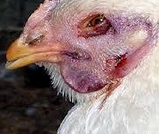
1. What is the antigenic variant for highly pathogenic avian influenza (HPAI) H5N1 virus?
Antigenic variant is defined as the virus which has distinct antigenicity with some other virus. Therefore, if virus A is predicted as antigenic variant of virus B, it could escape the immunity generated against virus B.
2. What is the antigenic correlation network (ACnet)?
It reflects the antigenic relationship between viruses. Only if two viruses are predicted to be antigenic similar, they are connected in the network.
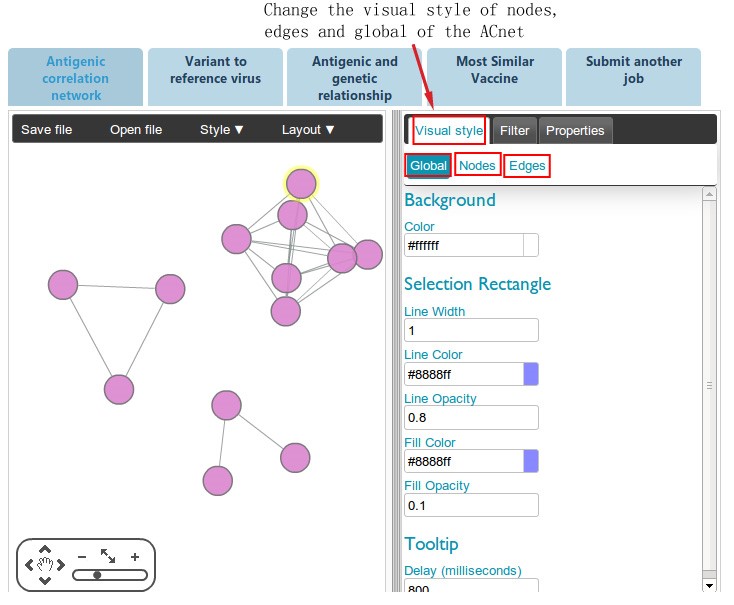
3. How to change the visual style of the ACnet?
The ACnet was displayed in the flash version of Cytoscape. Its visual style could be changed in an easy way as shown in the figure below. Either the global style or the node and edge styles could be changed by the user, such as the color and shape of the nodes.
4. How to predict the antigenic variant based on HA1 protein sequence?
The method used here for prediction of antigenic variant of HPAI H5N1 virus was developed in our previous work1. It was adapted from the method previously developed in seasonal influenza H3N2 virus in Du’s work2. The method is a naive bayes classifier, which incorporate 12 structural and physicochemical properties or features that have been reported to or are thought to affect the antigenic properties of influenza HA. These 12 features include five H5N1 virus HA epitopes identified above, five physicochemical properties of amino acids (hydrophobicity, volume, charge, polarity and ASA), receptor binding and glycosylation. For a given pair of viruses, the values for the 12-feature variables were calculated based on their HA1 sequences(1-320 aa). The HI dataset (described below) composed of dAH distance was used to train the model. Based on the model, an odds ratio was calculated for a given pair of viruses. It denotes the extent of antigenic variation between them. If the odds ratio is equal to or greater than 1, the antigenic relationship of the two viruses is regarded as antigenically distinct, otherwise as antigenically similar. The greater the odds ratio is, the more likely it is that the two viruses are antigenically similar.
5. What’s the dataset used for training the model?
The HA-inhibition (HI) dataset was used to train the model for prediction of antigenic variant of HPAI H5N1 virus. It was collected from relevant literatures and documents published by the collaborating centers of the WHO's global influenza surveillance network. Then, the Archetti-Horsfall distance (dAH) was used to measure the antigenic characteristics between viral strains. It was calculated as follows: dAH=sqrt(Hii*Hij/(Hij*Hji)) , where Hij refers to the HI titer of strain i relative to antisera raised against strain j. When the dAH of a pair of strains was measured in several independent HI assays, the median was used of all dAH calculated from these independent assays. The threshold for dAH distance was defined to be 4. When the dAH is equal to or greater than the threshold, the pair of vaccine strains was considered as antigenic variant pair; otherwise antigenic similar pair. Using the dAH measure, we derived a total of 270 pairs of viral strains (173 antigenic variant pairs and 97 antigenic similar pairs). The dataset could be downloaded here
6. What does the odds ratio mean?
The odds ratio measures the extent of antigenic difference between viruses. It is a semi-quantitative measure. If the odds ratio is equal to or greater than 1, the antigenic relationship of the two viruses is regarded as antigenically distinct, otherwise as antigenic similar. The greater the odds ratio is, the more likely the two viruses are antigenically distinct. If the number of amino acid differences between a pair of viruses is greater than 15, they are very likely to be antigenically distinct with a probability over 0.9. Therefore, we didn’t calculate the odds ratio for them. If the number of amino acid difference between a pair of viruses is less than 3, they are very likely to be antigenically similar with a probability over 0.9. Therefore, we didn’t calculate the odds ratio for them and output a "Min" instead of the predicted odds ratio. Besides, if the predicted odds ratio for a pair of viruses is equal to 0, it is also replaced with a "Min".
7. About the phylogenetic tree
The phylogenetic tree was built based on the HA protein sequences of the user-inputted test strains and the user-selected reference strains with the Phyml program (available at https://code.google.com/p/phyml/). The tree was displayed through the online tool Interactive Tree Of Life (available at http://itol.embl.de/index.shtml)
8. How to citing us?
If you use this web server in your work, please cite us as the following: Peng YS, Zou YQ, Li HL, Li KL, Jiang TJ. Inferring the antigenic epitopes for highly pathogenic avian influenza H5N1 viruses. Vaccine (2013) 10.1016/j.vaccine.2013.12.005
Reference
1 Peng YS, Zou YQ, Li HL, Li KL, Jiang TJ. Inferring the antigenic epitopes for highly pathogenic avian influenza H5N1 viruses. Vaccine (2013) 10.1016/j.vaccine.2013.12.005.
2 Du, X., et al. (2012). "Mapping of H3N2 influenza antigenic evolution in China reveals a strategy for vaccine strain recommendation." Nat Commun 3: 709.